Sudan’s gold sector operates through a dual-layered framework: artisanal small-scale mining and emerging commercial extraction. This structure shapes supply dynamics, pricing mechanisms, and export pathways for international buyers seeking to buy gold from Sudan. Understanding this architecture is fundamental to executing compliant, low-risk international gold trading.
Sudan Gold navigates this complexity as a licensed intermediary, connecting verified production with global demand. We do not speculate or aggregate informally. Every transaction follows a documented workflow anchored in Sudanese regulatory compliance and international due diligence standards.

Artisanal and Small-Scale Mining Dynamics
Artisanal and small-scale mining (ASM) represents the dominant production channel in Sudan, accounting for an estimated 70 to 80 percent of national output. Operations are concentrated in the Northern State, River Nile State, and Red Sea State, where alluvial deposits and shallow hard-rock veins are accessible with minimal mechanization.
ASM producers typically sell gold through local trading hubs or cooperative aggregators. Quality varies significantly, with purity ranging from 60 to 95 percent depending on processing methods. This fragmentation creates both opportunity and risk for international buyers. Reliable gold sourcing in Sudan requires on-the-ground verification, consistent assay protocols, and transparent chain-of-custody documentation.
Sudan Gold engages ASM partners through formalized agreements that include pre-qualification, site audits, and standardized quality benchmarks. This approach elevates informal production into a compliant export stream without disrupting local livelihoods.
Commercial Mining and Institutional Supply Channels
Commercial mining in Sudan remains nascent but is expanding through joint ventures between Sudanese license holders and international technical partners. These operations utilize mechanized extraction, cyanidation or gravity concentration processing, and on-site refining to produce doré bars or semi-refined bullion.
Key commercial zones include the Block 14 area in the Northern State and emerging projects in the Red Sea Hills. Production volumes are smaller than established African jurisdictions but offer strategic diversification for buyers seeking exposure to frontier supply.
For Sudan gold suppliers serving institutional clients, commercial operations provide more predictable output, standardized documentation, and clearer regulatory oversight. Sudan Gold prioritizes partnerships with licensed commercial entities that maintain auditable records and adhere to environmental and social governance protocols.
Regulatory Architecture and Export Licensing
The Sudan gold market functions within a multi-tiered regulatory system. The Ministry of Energy and Mining issues exploration and extraction licenses. The Ministry of Finance and Economic Planning oversees export permits, tax compliance, and revenue collection. The Sudanese Customs Authority manages physical border clearance.
Legal gold export from Sudan requires:
- Valid mining license or procurement agreement with a licensed entity
- Export authorization from the Ministry of Finance
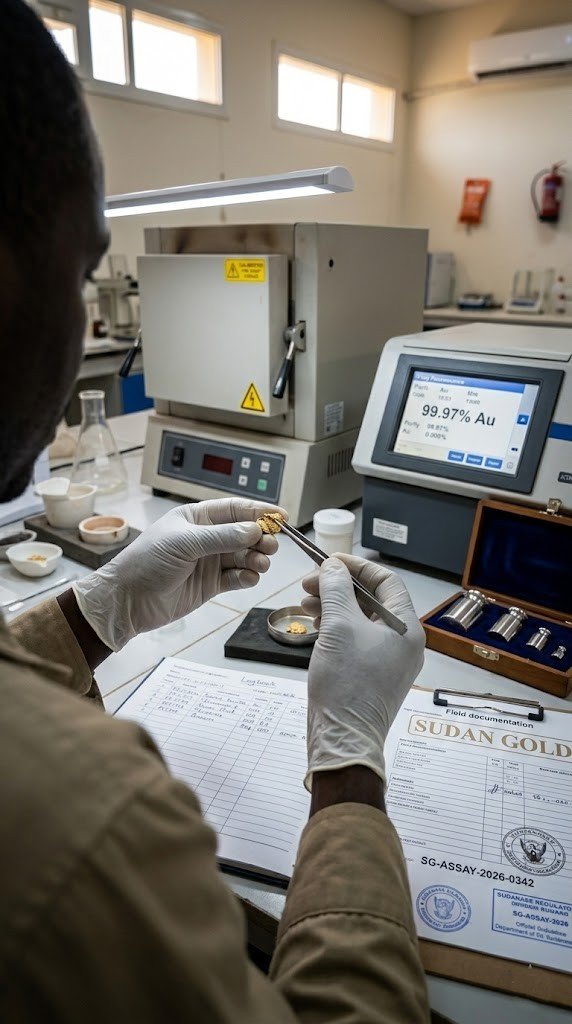
- Assay certificate from an accredited laboratory
- Tax clearance and royalty payment confirmation
- AML/KYC documentation aligned with FATF recommendations
This framework has strengthened in recent years to align with OECD Due Diligence Guidance and regional anti-illicit trade initiatives. Compliance is not optional for Sudan gold exporters targeting regulated markets in the EU, North America, or UAE.
Sudan Gold maintains an internal compliance unit that pre-validates all documentation before shipment initiation. This proactive approach minimizes clearance delays and strengthens buyer confidence.
Market Intermediation and Price Formation
Price discovery in Sudan’s gold market occurs through a hybrid mechanism. Local traders reference the LBMA gold price but apply discounts reflecting purity uncertainty, logistics risk, and informal premium structures. International buyers typically negotiate based on finalized assay results, not provisional estimates.
Sudan Gold employs a transparent pricing model:
- Provisional valuation: Based on preliminary field assay and LBMA reference.
- Final settlement: Adjusted post-independent laboratory confirmation.
- Currency terms: Quoted in USD with clear FX conversion methodology.
- Incoterms: Clearly defined (typically FCA Khartoum or FOB Port Sudan).
This structure reduces dispute risk and aligns expectations between Sudanese sellers and international purchasers.
Export Logistics and Cross-Border Pathways
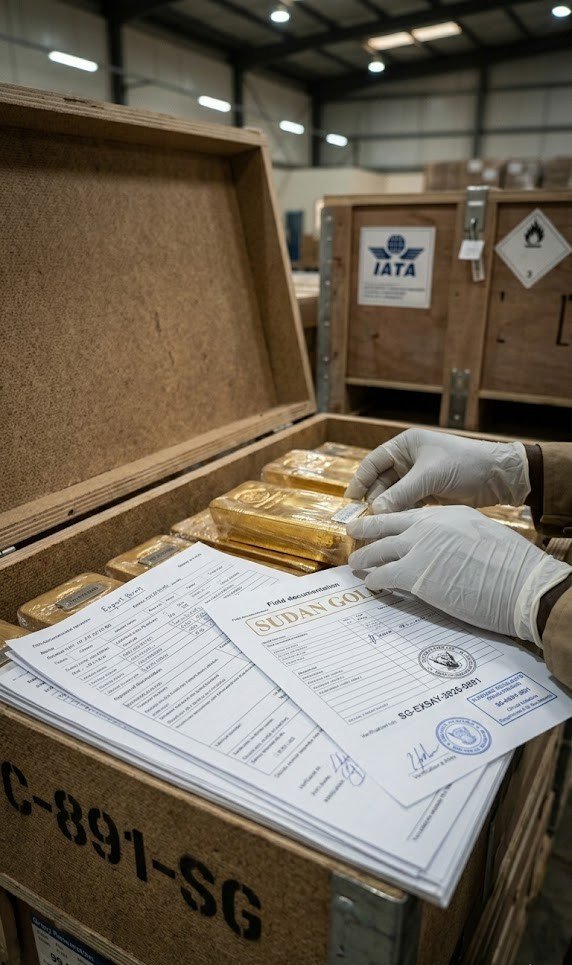
Physical movement of gold from Sudan to international markets follows established corridors. The primary route is Khartoum → Dubai (UAE), leveraging Dubai’s status as a global precious metals hub with streamlined import protocols for African gold. Secondary routes serve Europe (via Switzerland or Turkey), Asia (Singapore, India), and North America (via UAE or direct charter).
Critical logistics components include:
- Secure domestic transport: Armored, GPS-tracked vehicles with dual-authorization release protocols.
- Export clearance: Pre-submitted documentation to Sudanese Customs and Central Bank.
- International freight: Specialized high-value cargo carriers with all-risk insurance.
- Destination compliance: Pre-coordination with import agents to satisfy DMCC, LBMA, or local regulatory requirements.
Sudan Gold coordinates each stage through vetted partners, maintaining chain-of-custody integrity from mine to refinery.
Risk Mitigation and Buyer Due Diligence
International buyers evaluating gold sourcing in Sudan must assess three core risk categories: provenance uncertainty, regulatory exposure, and counterparty reliability. Sudan Gold addresses each through structured controls.
Provenance risk is managed through in-person batch verification, geotagged documentation, and cooperative registration checks. Regulatory risk is mitigated by maintaining current licenses, pre-clearing export paperwork, and aligning with international AML standards. Counterparty risk is reduced via escrow-supported payment terms, performance bonds, and transparent communication protocols.
These measures position Sudan Gold as a trusted gold exporter for institutions requiring defensible supply chains.
Strategic Positioning for Global Buyers
The Sudan gold market offers strategic advantages: competitive pricing relative to established African jurisdictions, geographic diversification, and access to underutilized reserves. However, these benefits are accessible only through partners who combine local operational knowledge with global compliance discipline.
Sudan Gold delivers this integration. We are not a remote broker. Our team conducts regular site visits, maintains direct relationships with licensed miners, and structures transactions to satisfy both Sudanese law and international buyer requirements.
Conclusion and Professional Engagement
The structure of Sudan’s gold market rewards informed, disciplined participants. Artisanal and commercial channels coexist, regulated frameworks continue to mature, and international demand remains robust. Success requires a partner who understands both the local operational reality and the global compliance landscape.
Sudan Gold provides that bridge. For refiners, institutional buyers, and sovereign entities seeking to buy gold from Sudan with verifiable provenance and institutional-grade documentation, we welcome confidential inquiry.
Explore our compliance framework and export capabilities at goldsudan.com.
Website: goldsudan.com Email: Sales@goldsudan.com