Operating as a gold exporter in Sudan is a privilege granted only to entities that meet rigorous statutory, financial, and operational criteria. The Sudanese government maintains strict control over the precious metals sector to ensure revenue retention, prevent illicit trade, and align with international anti-money laundering (AML) standards. For international buyers seeking to buy gold from Sudan, verifying that their partners hold valid, current licenses is the first and most critical step in due diligence. It is the definitive marker separating legitimate Sudan gold exporters from the informal market.
Sudan Gold operates with full regulatory compliance, holding all necessary licenses issued by the relevant Sudanese authorities. Our transparent licensing status provides institutional buyers with the confidence required for high-value international gold trading.
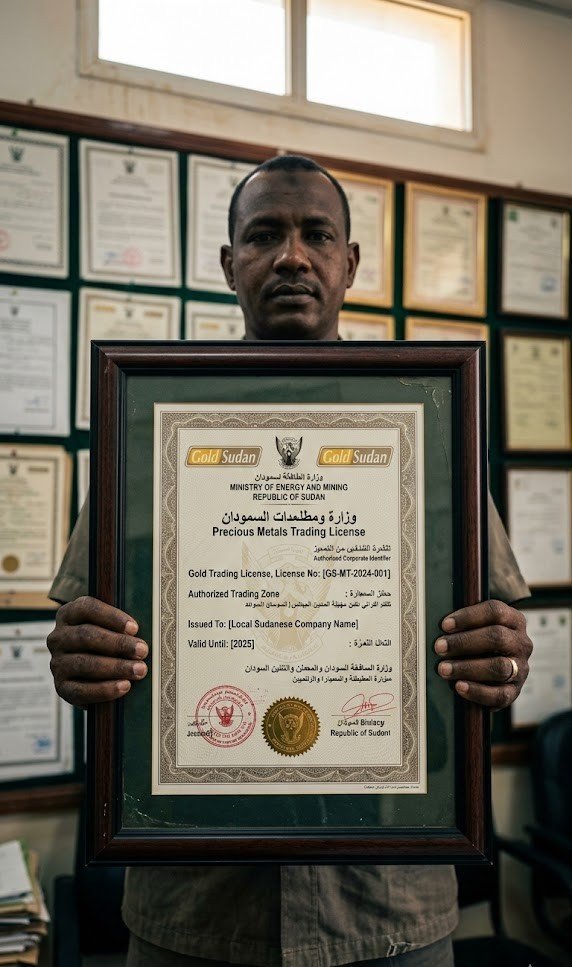
The Regulatory Triad: Who Issues Licenses?
Gold export licensing in Sudan is not managed by a single entity but requires coordination across three key government bodies, each with specific oversight responsibilities:
- Ministry of Energy and Mining (MoEM): Responsible for issuing mining licenses and validating the source of the gold. They ensure that the exporter has legal rights to the material or valid procurement agreements with licensed miners.
- Ministry of Finance and Economic Planning (MoFEP): Issues the actual Export Permits for each shipment and oversees tax compliance, royalties, and fiscal obligations.
- Central Bank of Sudan (CBOS): Regulates foreign exchange transactions, validates the repatriation of export proceeds, and issues monetary approvals required for cross-border gold movement.
An exporter must be in good standing with all three bodies to operate legally. Any gap in this triad renders an export operation invalid and high-risk.
Core Licensing Categories
To legally export gold, an entity must secure specific categories of licenses and registrations:
1. General Commercial Registration & Tax ID
Before applying for sector-specific licenses, the company must be a legally registered entity in Sudan.
- Requirement: Valid Commercial Registration (CR) from the Registrar of Companies.
- Tax ID: Registration with the Zakat and Tax Authority.
- Relevance: Establishes the legal personality of the exporter and ensures they are subject to Sudanese law.
2. Precious Metals Trading License
Issued by the Ministry of Energy and Mining, this is the primary operational license.
- Scope: Authorizes the holder to buy, sell, aggregate, and trade gold within Sudan.
- Conditions: Requires proof of secure storage facilities (vaults), qualified staff, and a clean criminal record for directors.
- Renewal: Typically annual, subject to audit of previous trading volumes and compliance history.
3. Exporter License (Specific to Gold)
Distinct from the general trading license, this specific authorization permits the cross-border movement of gold.
- Issuing Body: Jointly validated by MoEM and MoFEP.
- Criteria: Demonstrated capacity to handle international logistics, adherence to AML/CFT (Combating the Financing of Terrorism) protocols, and membership in the Sudanese Chamber of Commerce.
- Validity: Often tied to specific performance metrics and regular compliance reporting.

Mandatory Compliance & Operational Prerequisites
Obtaining the license is only the first hurdle. Maintaining it requires ongoing adherence to strict operational standards:
- Secure Storage Facilities: Licensed exporters must possess or lease approved vaults meeting specific security standards (CCTV, armed guards, dual-control access) inspected by the Ministry of Interior.
- AML/KYC Protocols: Implementation of robust Anti-Money Laundering and Know Your Customer systems aligned with FATF recommendations. This includes maintaining detailed records of all suppliers and buyers.
- Regular Audits: Licensed exporters are subject to periodic audits by the Ministry of Finance and the Central Bank to verify transaction volumes against declared taxes and royalties.
- Local Content Requirements: Preference is often given to entities that demonstrate investment in local communities or partnerships with Sudanese nationals.
The Shipment-Level Authorization: Export Permit
Even with a valid exporter license, every individual shipment requires a specific Export Permit. This is not a standing license but a transaction-specific authorization.
- Application: Submitted to the Ministry of Finance for each consignment.
- Supporting Docs: Must include the assay certificate, proof of tax/royalty payment, and the commercial invoice.
- Approval: Once granted, this permit acts as the “passport” for the gold, allowing it to clear Sudanese customs and board international flights.
For gold sourcing in Sudan, buyers must insist on seeing both the company’s standing Exporter License and the specific Export Permit for their shipment.
Verification for International Buyers
How can international buyers verify these licenses?
- Request Copies: Ask for certified copies of the Commercial Registration, Precious Metals Trading License, and Exporter License.
- Cross-Check: Verify license numbers with the respective Sudanese ministries (often possible through local legal counsel or chambers of commerce).
- Validate Export Permits: Ensure the Export Permit for your specific shipment matches the weight, purity, and destination details exactly.
- Check Standing: Confirm there are no pending suspensions or legal disputes against the licensee.
Sudan Gold welcomes this level of scrutiny. We provide full transparency regarding our licensing status, understanding that trust in international gold trading is built on verifiable facts, not assurances.

Why Licensing Matters for Risk Mitigation
Dealing with unlicensed exporters exposes buyers to severe risks:
- Seizure of Cargo: Illicit gold is frequently confiscated by customs authorities, resulting in total financial loss.
- Legal Liability: Buyers may face prosecution for receiving stolen or conflict-linked minerals.
- Reputational Damage: Association with illegal trade can destroy relationships with banks, refineries, and regulators.
- No Recourse: Unlicensed operators operate outside the legal framework, offering no contractual protection or dispute resolution mechanisms.
Sudan Gold eliminates these risks by operating fully within the licensed framework. Our compliance is our competitive advantage, ensuring that every gram of gold export from Sudan we facilitate is clean, legal, and secure.
Conclusion and Professional Call to Action
Licensing requirements for Sudan gold exporters are stringent for a reason: they protect the integrity of the global supply chain. For institutional buyers, verifying these licenses is non-negotiable. It is the foundation upon which secure, long-term partnerships are built.
Sudan Gold stands ready to demonstrate our full compliance. We invite refiners, sovereign funds, and institutional investors to request our licensing documentation and experience the peace of mind that comes with partnering with a fully authorized, transparent, and professional exporter.
Contact us today to verify our credentials and discuss your gold procurement needs.
Website: goldsudan.com Email: Sales@goldsudan.com