In the high-stakes environment of gold export from Sudan, the assay report is the single most critical document in any transaction. It is the definitive scientific verdict on the value of the cargo, determining the exact amount of fine gold contained within a batch of doré bars. For institutional buyers and refiners, understanding the assay testing procedures for Sudanese gold is essential to verify pricing, manage refining yields, and ensure contractual compliance. Discrepancies in assay results are the primary source of trade disputes; therefore, a rigorous, transparent, and internationally recognized testing protocol is non-negotiable.
Sudan Gold adheres to the Fire Assay method the global industry standard for precision conducted in accredited laboratories. We do not rely on estimates or handheld scanners for final valuation. Our process is designed to provide data that is accepted by major refineries in Dubai, Zurich, and London, ensuring seamless reconciliation and trust in every shipment.
The Critical Importance of Representative Sampling
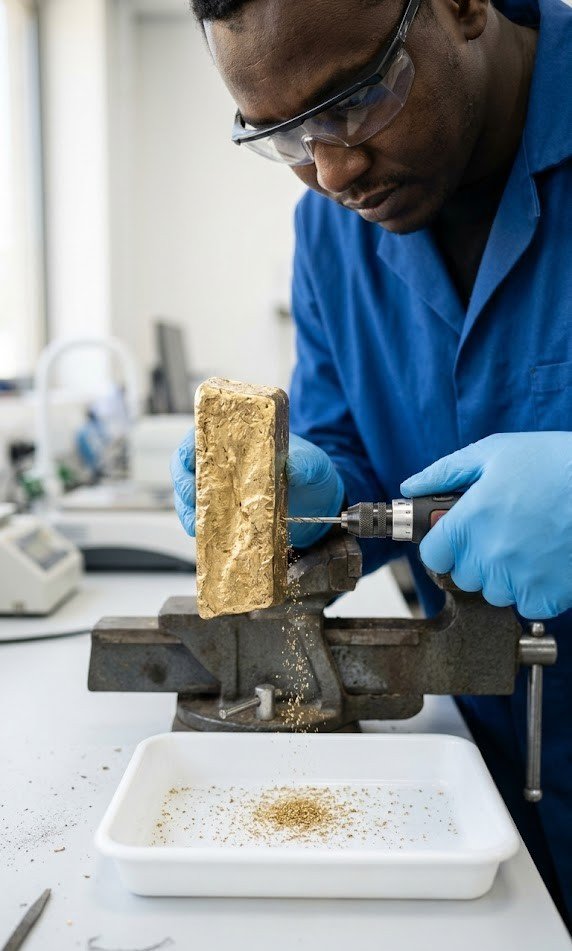
The accuracy of an assay begins long before the furnace is lit; it starts with sampling. If the sample does not accurately represent the entire batch, the result is worthless.
- Homogenization: Before sampling, doré bars are often melted and granulated or drilled at multiple points to ensure the mixture of gold, silver, and copper is uniform.
- Multi-Point Drilling: For solid bars, samples are taken from multiple locations (top, bottom, center, edges) to account for segregation of metals during cooling.
- Quartering Method: For gold dust or granules, the “cone and quarter” method is used to reduce a large batch to a small, statistically representative sample without bias.
- Dual-Witness Protocol: At Sudan Gold, sampling is always conducted in the presence of two authorized officers (and optionally the buyer’s representative) to prevent tampering or cherry-picking.
The Fire Assay Process: Step-by-Step
Once the sample is secured, it undergoes the Fire Assay process, which has been the benchmark for gold analysis for centuries due to its unparalleled accuracy.
1. Fusion
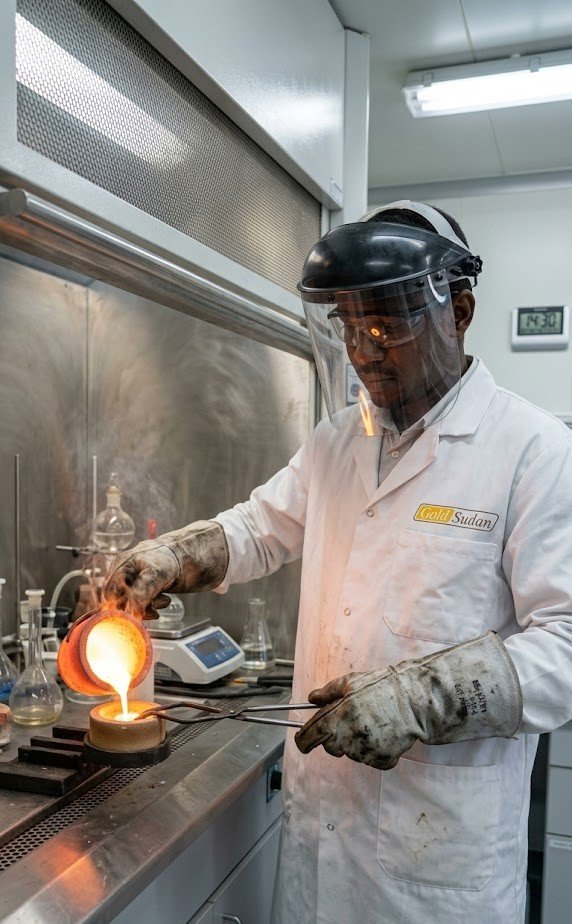
The sample is weighed precisely and mixed with a flux (typically lead oxide, silica, borax, and soda ash). This mixture is placed in a clay crucible and heated in a furnace to over 1000°C. The flux melts and dissolves the base metals, while the lead collects the precious metals (gold and silver) into a heavy button at the bottom.
2. Cupellation
The molten lead button containing the precious metals is poured into a porous bone-ash cupel and returned to the furnace. Air is blown over the surface, oxidizing the lead. The molten lead oxide (litharge) is absorbed by the cupel, leaving behind a small, shiny button of pure gold and silver.
3. Parting
The gold-silver button is flattened and treated with hot nitric acid. The acid dissolves the silver (and any remaining base metals) but leaves the gold intact. This step isolates the pure gold.
4. Annealing and Weighing
The remaining pure gold bead is annealed (heated) to remove stress and then weighed on a micro-balance with precision up to 0.01 milligrams. The ratio of this final weight to the original sample weight determines the exact purity (fineness) of the batch.
Alternative Methods: XRF and ICP
While Fire Assay is the standard for final settlement, other methods play a supportive role:
- X-Ray Fluorescence (XRF): Used for rapid, non-destructive preliminary screening of doré bars. While fast, XRF only analyzes the surface and can be inaccurate if the bar is not homogeneous. We use it for initial sorting but never for final pricing.
- Inductively Coupled Plasma (ICP): Used for detecting trace impurities (e.g., mercury, lead, platinum group metals) that might affect refining chemistry. It complements Fire Assay by providing a full elemental profile.
Accreditation and Quality Control
To ensure our assay results are globally accepted, Sudan Gold partners with laboratories that meet strict criteria:
- ISO/IEC 17025 Accreditation: Our partner labs are accredited to this international standard for testing and calibration, ensuring technical competence and unbiased results.
- Certified Reference Materials (CRMs): Labs regularly test known standards to calibrate their equipment and verify accuracy.
- Blind Duplicates: Random duplicate samples are tested to check for consistency and operator error.
- Third-Party Verification: Buyers are encouraged to send their own independent samples to external labs (e.g., in Dubai or Switzerland) to cross-verify our results.
Reconciliation and Dispute Resolution
Despite rigorous protocols, minor variances between the exporter’s assay and the destination refinery’s assay can occur due to sampling differences.
- Tolerance Bands: Contracts typically include a tolerance band (e.g., ±0.5% for gold content). Variances within this range are usually accepted without adjustment.
- Final Settlement: For significant discrepancies, the assay from the destination refinery (the “final call”) typically governs the final payment, provided their methods are also accredited.
- Arbitration: In rare cases of major dispute, an independent third-party arbiter can be appointed to review the data and methods of both parties.

Conclusion
Assay testing procedures for Sudanese gold are the bedrock of trust in the trade. By adhering to the rigorous Fire Assay method and maintaining strict accreditation standards, Sudan Gold ensures that every percentage point of purity reported is accurate, defensible, and aligned with global expectations. This commitment to scientific precision eliminates ambiguity, protects the interests of both buyer and seller, and facilitates smooth, dispute-free transactions in the international market. In the business of gold, the assay is not just a number; it is the promise of value.
Website: goldsudan.com Email: Sales@goldsudan.com