For institutional buyers and exporters, understanding how refineries evaluate Sudan gold is the key to unlocking maximum value and ensuring seamless market access. A refinery does not simply buy “gold”; it purchases a specific chemical feedstock that must be processed efficiently, safely, and profitably. When doré bars from Sudan arrive at major refining hubs like Dubai, Zurich, or Perth, they undergo a rigorous technical and commercial assessment that goes far beyond a simple purity check. This evaluation determines the final settlement price, refining charges, and the speed of intake.
Sudan Gold prepares every shipment with these specific refinery criteria in mind. By aligning our sourcing, assaying, and documentation processes with the exact requirements of top-tier refineries, we ensure that our partners’ gold is welcomed as premium feedstock, minimizing deductions and maximizing returns.
The Intake Process: First Impressions Matter
The evaluation begins the moment the shipment arrives at the refinery gate.
- Seal Verification: Security teams verify that the tamper-evident seals on the crates match the air waybill and export documents. Any sign of breach results in immediate quarantine.
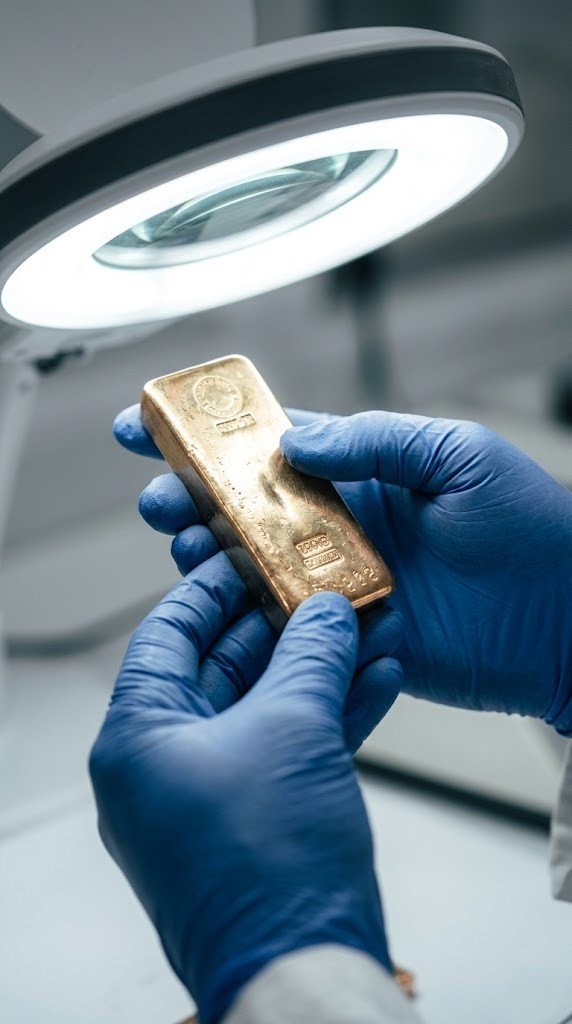
- Visual Inspection: Metallurgists examine the physical condition of the doré bars. They look for:
- Homogeneity: Signs of proper melting (smooth surface, consistent color).
- Contamination: Visible slag, sand, or foreign materials embedded in the bar, which can lower recovery rates.
- Stamping: Clear, legible serial numbers and weight stamps that match the accompanying assay certificate.
- Weighing: Bars are weighed on certified industrial scales to verify gross weight against the shipping manifest. Discrepancies greater than 0.1% trigger a full investigation.
The Critical Role of Independent Assaying
While Sudan Gold provides a pre-export assay, the refinery conducts its own independent analysis to determine the final settlement.
- Sampling: The refinery takes its own representative sample, often by drilling multiple points or clipping edges, to ensure it reflects the entire batch.
- Fire Assay & ICP: They perform their own Fire Assay for gold content and ICP-MS for trace impurities.
- Reconciliation: The refinery’s result is compared to the exporter’s certificate.
- Within Tolerance: If the variance is within the contractual limit (typically ±0.5% for gold), the exporter’s figure usually stands, or an average is taken.
- Outside Tolerance: If the variance is significant, the refinery’s result typically becomes the “final call” for payment, potentially leading to financial adjustments.
Evaluating Impurity Profiles: The Hidden Costs
Refineries scrutinize the type of impurities in Sudanese gold, as this directly impacts their processing costs and chemistry.
- Silver Content: High silver (common in Sudanese doré) is often beneficial as it can be recovered and sold. However, extremely high levels may require specific parting processes.
- Base Metals (Copper, Iron, Lead): These are detrimental. They consume more flux, increase energy consumption, and generate more slag. High levels of base metals often result in higher Treatment Charges (TCs) or penalties.
- Hazardous Elements: Trace amounts of mercury, arsenic, or antimony are strictly monitored due to environmental regulations. Their presence can lead to rejection or significant surcharges for specialized handling.
Sudan Gold’s pre-export ICP testing allows us to identify these elements early, ensuring buyers are aware of any potential refining implications before the gold leaves Khartoum.

Commercial Terms: Treatment Charges and Penalties
The evaluation directly dictates the commercial terms of the deal.
- Treatment Charges (TCs): A fee charged by the refinery to cover the cost of processing the impurities. Higher impurity levels = higher TCs.
- Refining Charges (RCs): A percentage fee based on the value of the fine gold recovered.
- Penalties: Specific fines applied for hazardous elements (e.g., Mercury > 1ppm) or difficult-to-process matrices.
- By-Product Credits: If the gold contains recoverable silver or platinum group metals, the refinery may credit the buyer for a portion of their value.
Understanding these levers allows buyers to negotiate better contracts and select the most suitable refinery for their specific doré profile.
Why Sudan Gold’s Preparation Matters
Refineries favor suppliers who consistently deliver clean, well-documented, and homogeneous doré.
- Faster Intake: Clean shipments bypass extended quarantine periods, speeding up payment.
- Lower Charges: Consistent quality builds trust, often leading to negotiated discounts on TCs/RCs.
- Reduced Disputes: Accurate pre-export assays minimize reconciliation gaps, preventing payment delays.
By rigorously controlling our production and testing standards, Sudan Gold ensures that our partners’ gold is evaluated as premium feedstock, optimizing their net returns.

Conclusion
How refineries evaluate Sudan gold is a multifaceted process blending scientific precision with commercial pragmatism. It is not merely about purity; it is about the total cost of ownership, including impurity profiles, refining efficiency, and regulatory compliance. Sudan Gold understands this landscape intimately. By delivering doré that meets the highest technical standards and providing transparent, accurate data, we ensure that our partners’ gold is evaluated favorably, resulting in faster settlements, lower charges, and maximized value in the global market.
Website: goldsudan.com Email: Sales@goldsudan.com