In the high-stakes world of international gold trading, the margin for error is non-existent. For institutional buyers sourcing from Sudan, quality control in gold procurement is the definitive barrier between a profitable transaction and a catastrophic loss. The variability of artisanal output ranging from raw nuggets to fine dust demands a rigorous, multi-layered verification process to ensure that every shipment meets exact purity and weight specifications. Without robust quality controls, buyers face the risks of overpayment, refinery rejections, and compliance failures.
Sudan Gold has institutionalized a “Zero-Defect” quality assurance framework. We do not rely on spot checks; we implement a continuous chain of verification from the moment gold is unearthed in the Northern State to its final sealing in Khartoum. Our protocols are designed to exceed the intake standards of major global refineries, ensuring that our doré bars are trusted, bankable, and ready for immediate processing.
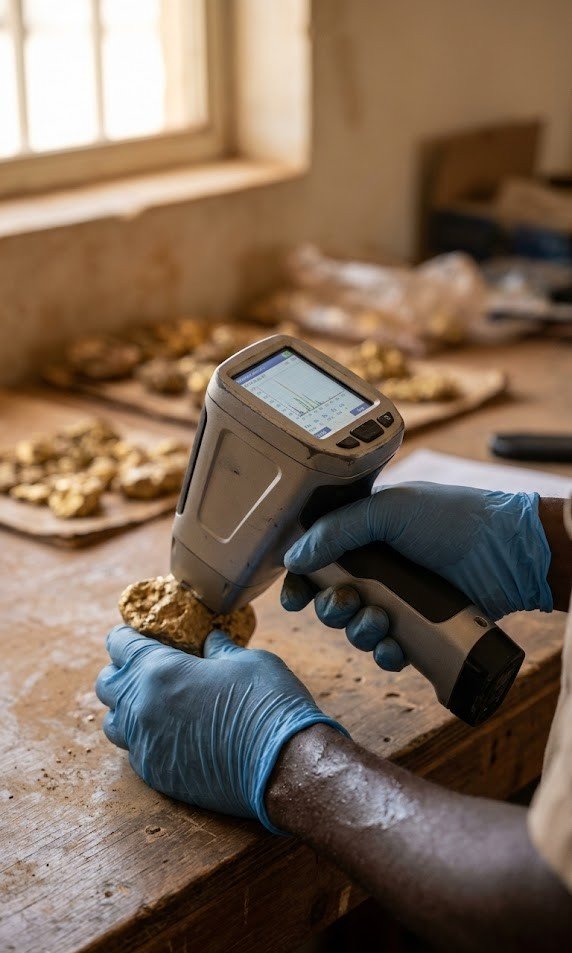
Stage 1: Field-Level Preliminary Screening
Quality control begins at the source, long before the gold reaches a laboratory.
- Visual Inspection: Our trained procurement officers conduct immediate visual assessments of raw gold at cooperative collection points. They check for obvious impurities, foreign materials, or signs of tampering.
- Handheld XRF Analysis: We utilize portable X-Ray Fluorescence (XRF) analyzers to perform non-destructive preliminary purity tests on-site. This provides an instant estimate of gold content (e.g., 85% vs. 92%), allowing us to flag low-grade material immediately.
- Moisture and Contaminant Checks: For gold dust, we perform simple density and moisture tests to ensure sellers are not adding water or sand to increase weight artificially.
- Rejection Protocol: Any batch failing these initial checks is rejected on the spot, preventing substandard material from entering our logistics chain.
Stage 2: Secure Intake and Sampling
Once the gold arrives at our central facility in Khartoum, it undergoes a more rigorous intake process.
- Seal Verification: The integrity of transport seals is verified against the chain-of-custody log. Any discrepancy triggers an immediate security investigation.
- Representative Sampling: This is the most critical step. Using established statistical methods (such as the “quartering” method for dust or drill sampling for bars), we extract a small, representative sample from each batch.
- Dual-Witness Procedure: Sampling is always conducted in the presence of two authorized officers to prevent bias or manipulation. The sample is immediately sealed in a tamper-evident bag with a unique ID.
- Chain of Custody: The sample is logged and transferred directly to the laboratory under strict security, ensuring it cannot be swapped or altered.
Stage 3: Laboratory Fire Assay Certification
The definitive measure of quality is the fire assay, the global industry standard for precision.
- Accredited Testing: Samples are sent to ISO-accredited laboratories in Khartoum (or internationally recognized partners if required) for fire assay testing.
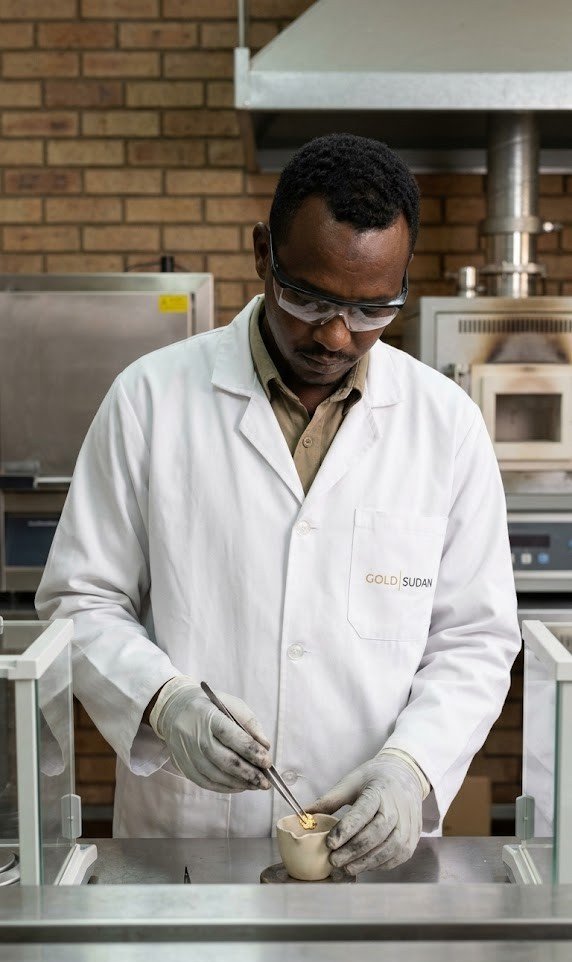
- Process: The sample is melted with lead and flux in a furnace, separating pure gold from base metals and impurities. The resulting bead is weighed to determine the exact fine gold content with precision up to 0.01%.
- Impurity Profiling: The assay also identifies specific impurities (e.g., silver, copper, iron), which is crucial for refineries to plan their refining chemistry.
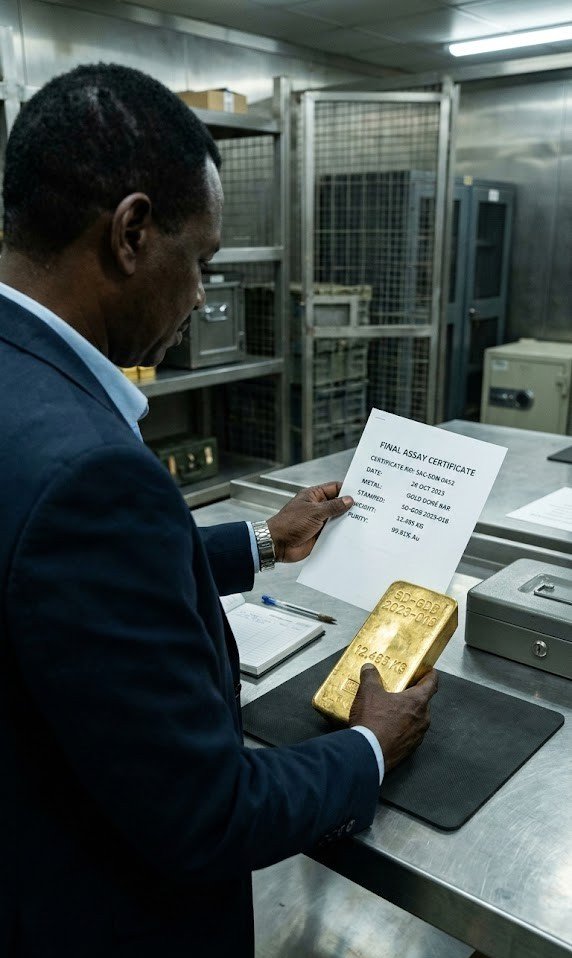
- Final Certificate: A formal Assay Certificate is issued, detailing the gross weight, fine gold weight, purity percentage, and impurity profile. This document forms the legal basis for pricing and export declaration.
Stage 4: Consolidation and Standardization
Quality control also involves standardizing the physical form of the gold for export.
- Homogenization: During the melting and casting of doré bars, we ensure the molten gold is thoroughly mixed to eliminate pockets of varying purity.
- Bar Stamping: Each finished bar is stamped with its unique serial number, gross weight, and batch ID. These markings are cross-referenced with the assay certificate.
- Final Visual Audit: Before sealing, every bar is visually inspected for cracks, voids, or surface irregularities that could indicate poor casting or internal flaws.
Stage 5: Third-Party Verification and Reconciliation
To provide maximum assurance to international buyers, we support independent verification.
- Buyer Representation: Buyers are welcome to send their own representatives to witness the sampling and assaying process in Khartoum.
- Destination Assay: We acknowledge that final reconciliation often occurs at the destination refinery. Our contracts include clear terms for handling minor variances (typically within ±0.5%) between the Khartoum and destination assays.
- Dispute Resolution: In the rare event of a significant discrepancy, we have protocols for engaging independent third-party arbiters to resolve the issue fairly.
Conclusion
Quality control in Sudan gold procurement is not a single step but a comprehensive culture of precision and integrity. From the dusty fields of artisanal mines to the high-tech laboratories of Khartoum, every gram of gold is subjected to relentless scrutiny. Sudan Gold’s commitment to this rigorous framework ensures that our international partners receive a product that is exactly what was promised: pure, verified, and compliant. In a market where trust is the ultimate currency, our unwavering standards are our greatest asset.
Website: goldsudan.com Email: Sales@goldsudan.com