In the complex logistics of international gold trade, the choice between CIF (Cost, Insurance, and Freight) and FOB (Free On Board) is not merely a shipping preference; it is a fundamental allocation of risk, cost, and control. For buyers sourcing from Sudan, understanding these Incoterms is critical because they dictate who is responsible for the cargo at every second of its journey from the vault in Khartoum to the refinery in Dubai or Zurich. A misinterpretation can lead to uninsured losses, unexpected costs, or legal disputes over liability during transit. While CIF offers a “hands-off” approach for the buyer, FOB provides greater control and transparency, often preferred by sophisticated institutional buyers who have their own trusted logistics and insurance networks.
Sudan Gold is proficient in both models, tailoring the shipment terms to the specific risk appetite and operational capabilities of our partners. We ensure that regardless of the term chosen, the chain of custody remains unbroken and fully insured.
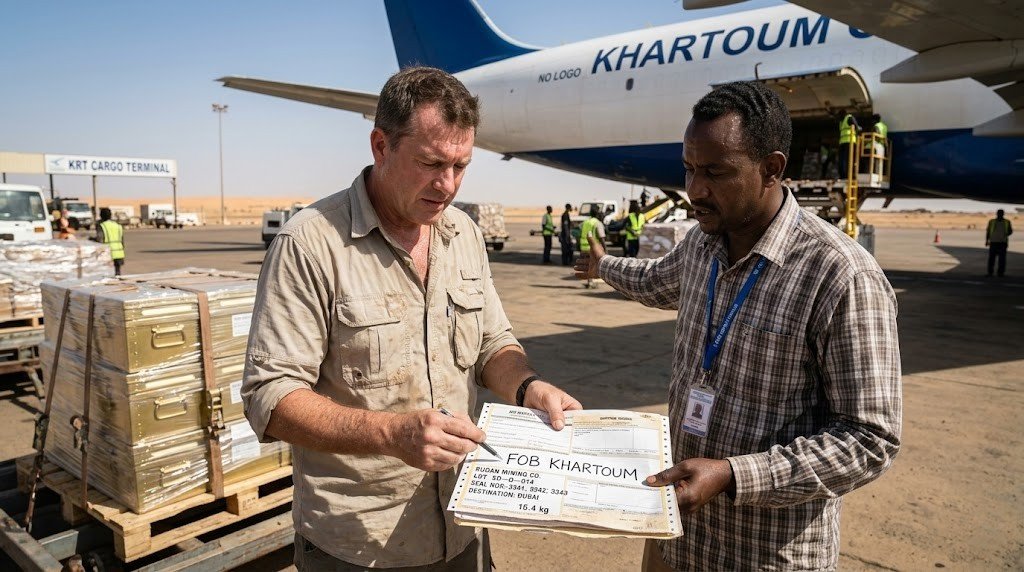
FOB (Free On Board): The Buyer’s Control Model
Under FOB [Named Airport/Port], the seller’s responsibility ends once the goods are loaded onto the vessel or aircraft at the origin.
- Seller’s Duty: Sudan Gold handles all export formalities, security transport to the airport, and loading onto the plane. Once the cargo crosses the ship’s rail (or enters the aircraft hold), our liability ceases.
- Buyer’s Duty: The buyer arranges and pays for the main carriage (flight), marine/all-risk insurance, and destination clearance.
- Risk Transfer: Risk passes to the buyer the moment the gold is loaded. If the plane encounters turbulence or delays, it is the buyer’s insurance that responds.
- Why Choose FOB?
- Control: Buyers with existing global logistics contracts can leverage better freight rates and choose their own security providers.
- Visibility: Direct relationship with the carrier allows real-time tracking without intermediary filters.
- Insurance Certainty: Buyers can ensure their own policy covers specific high-value risks that standard seller policies might exclude.
CIF (Cost, Insurance, and Freight): The Seller’s Convenience Model
Under CIF [Named Destination], the seller pays for the cost of the goods, insurance, and freight to the named destination.
- Seller’s Duty: Sudan Gold arranges the flight, pays the freight charges, and procures minimum insurance coverage (usually 110% of invoice value) up to the destination airport.
- Buyer’s Duty: The buyer takes responsibility only upon arrival at the destination. They handle import customs, local taxes, and transport from the destination airport to the refinery.
- Risk Transfer: Crucially, while the seller pays for freight and insurance, the risk still typically passes to the buyer once the goods are loaded at the origin (per Incoterms 2020 rules). The seller essentially buys insurance on behalf of the buyer.
- Why Choose CIF?
- Simplicity: Ideal for buyers who lack established logistics networks in Africa.
- Predictability: A single landed price makes budgeting easier.
- Hassle-Free: The seller manages all complexities of export and transit.

Key Differences & Strategic Implications
| Feature | FOB (Free On Board) | CIF (Cost, Insurance, Freight) |
|---|---|---|
| Freight Cost | Paid by Buyer | Paid by Seller |
| Insurance | Arranged by Buyer | Arranged by Seller (for Buyer’s benefit) |
| Risk Transfer | At Origin (Loading) | At Origin (Loading)* |
| Control | High (Buyer chooses carrier) | Low (Seller chooses carrier) |
| Best For | Institutional buyers with logistics teams | New buyers or smaller transactions |
*Note: Under CIF, the seller pays for the journey, but the risk of loss/damage usually transfers to the buyer once goods are loaded at origin. The seller just holds the insurance policy in trust for the buyer.
Common Pitfalls to Avoid
- Assuming Risk Matches Cost: In CIF, many buyers mistakenly think the seller bears the risk until arrival. They do not. If the cargo is lost, the buyer must claim against the insurance policy provided by the seller.
- Inadequate Insurance: Standard CIF insurance often covers only minimum risks (Institute Cargo Clauses C). For gold, buyers must insist on “All-Risk” (Clause A) coverage including theft, pilferage, and non-delivery.
- Hidden Charges: In FOB, buyers must verify if “loading charges” at the origin airport are included in the seller’s price or billed separately by the ground handler.

Conclusion
Understanding CIF and FOB in gold shipping is essential for managing risk and cost effectively. While CIF offers convenience for those new to the Sudan corridor, FOB provides the control and transparency demanded by large-scale institutional players. Sudan Gold works flexibly with both models, ensuring that whether you choose to manage the logistics yourself or rely on our comprehensive service, your gold moves securely, efficiently, and with clear liability definitions. In the global trade of gold, clarity on who owns the risk at every mile is the foundation of a successful partnership.
Website: goldsudan.com Email: Sales@goldsudan.com