In the global precious metals market, precision in language is as valuable as the metal itself. For institutional buyers sourcing from Sudan, understanding the distinction between gold fineness and karat standards is fundamental to accurate valuation, contract drafting, and refining planning. While both terms measure purity, they are used in different contexts: fineness (parts per thousand) is the scientific standard used in international trade, banking, and refining, whereas karats (parts per 24) are primarily used in jewelry manufacturing and retail. Confusing these two can lead to significant pricing errors and contractual misunderstandings.
Sudan Gold operates exclusively on the fineness standard for all export documentation and commercial invoices, aligning with the requirements of major refineries and central banks. However, we provide clear conversions and educational support to ensure our partners across all sector whether refiners or jewelers fully understand the quality of the gold export from Sudan.

Fineness vs. Karats: The Core Difference
The primary distinction lies in the base unit of measurement:
- Fineness (Parts per Thousand): This expresses purity as the number of parts of pure gold in 1,000 parts of the alloy.
- Example: 999.9 fine means 999.9 parts gold out of 1,000 (99.99% pure). This is the standard for investment bullion and refinery intake.
- Sudan Context: Sudanese doré bars typically range from 850 to 920 fine (85%–92% pure), depending on the mine source.
- Karat (Parts per 24): This expresses purity as the number of parts of pure gold in 24 parts of the alloy.
- Example: 24 Karat (24K) is pure gold. 18 Karat (18K) is 18 parts gold and 6 parts other metals (75% pure).
- Usage: Common in jewelry markets (e.g., India, Middle East) but rarely used in bulk wholesale contracts.
Conversion Table: Fineness to Karats
For buyers accustomed to karats, here is a quick reference for typical Sudanese doré grades:
| Fineness (Parts/1000) | Percentage (%) | Approximate Karat | Typical Use Case |
|---|---|---|---|
| 999.9 | 99.99% | 24K | Refined Bullion (Investment) |
| 916 | 91.6% | 22K | High-Grade Doré / Jewelry Gold |
| 875 | 87.5% | ~21K | Standard Sudanese Doré |
| 833 | 83.3% | ~20K | Lower-Grade Doré |
| 750 | 75.0% | 18K | Jewelry Alloy (Not typical for export) |
Note: Sudan Gold exports primarily in the 850–920 fine range. Exact fineness is determined by assay for each batch.
Why Fineness is the Trade Standard
International trade relies on fineness for several critical reasons:
- Precision: Fineness allows for decimal precision (e.g., 912.5 fine), which is essential for calculating exact value in multi-million dollar transactions. Karats are too coarse (whole numbers) for this level of accuracy.
- Mathematical Simplicity: Calculating the weight of pure gold is straightforward:
Gross Weight × (Fineness / 1000) = Fine Gold Weight. - Global Uniformity: Refineries, banks, and exchanges (LBMA, COMEX) universally use fineness. Using karats would require conversion at every step, introducing room for error.
Implications for Pricing and Refining
Understanding the specific fineness of your Sudanese gold shipment directly impacts your bottom line:
- Valuation: You only pay for the fine gold content. If you buy 10kg of 900 fine gold, you are buying 9kg of pure gold and 1kg of impurities (silver, copper, etc.). The price is calculated on the 9kg.
- Refining Costs: Lower fineness means higher impurity content, which may increase refining charges (flux costs, energy, time) at the destination. Knowing the exact fineness helps you budget these downstream costs accurately.
- Silver Credit: If the impurity profile shows significant silver content (common in Sudanese doré), refineries often credit the buyer for the recovered silver. Accurate fineness data includes this breakdown.
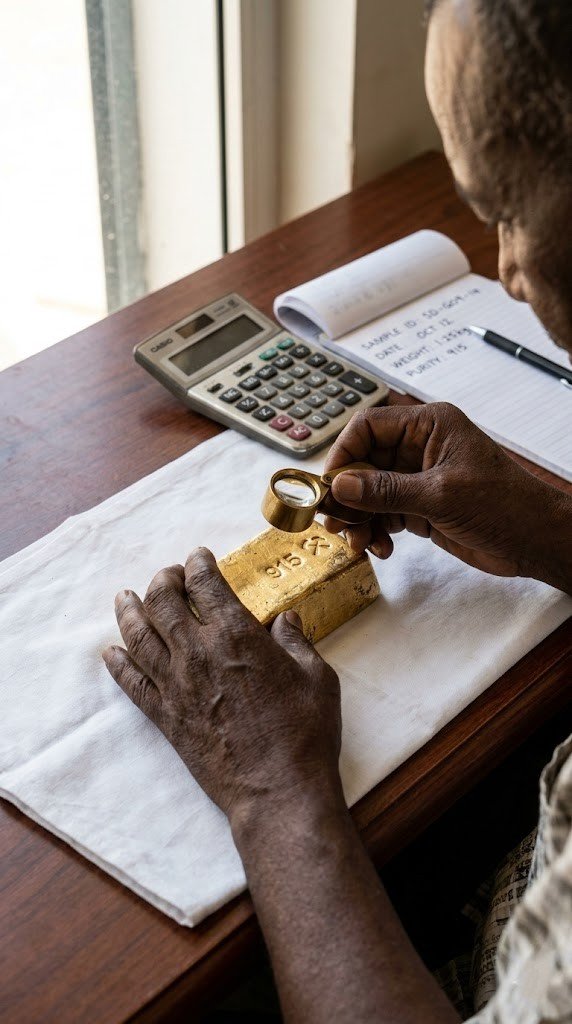
Common Misconceptions to Avoid
- “22 Karat” vs. “916 Fine”: While often used interchangeably in jewelry, in bulk trade, always specify “916 fine” to avoid ambiguity.
- Assuming Uniformity: Not all doré bars from the same region have identical fineness. Geological variations occur. Always rely on the specific assay certificate for each batch, not regional averages.
- Ignoring Impurities: Fineness tells you the gold content, but a full assay also details what the non-gold parts are (silver vs. copper). This matters for refining chemistry.
Sudan Gold’s Commitment to Clarity
We ensure total transparency in our purity reporting:
- Dual Reporting: While our contracts use fineness, we can provide karat equivalents for clients who need them for internal jewelry divisions.
- Detailed Assays: Our certificates break down the exact percentage of gold, silver, copper, and other trace elements, giving a complete picture of the alloy.
- Educational Support: Our team is available to walk buyers through the data, ensuring they understand exactly what they are purchasing.

Conclusion
Understanding gold fineness and karat standards is essential for navigating the complexities of international gold trading. While karats serve the jewelry world well, fineness is the precise, universal language of bulk commerce and refining. By mastering this distinction and relying on accurate assay data, buyers can ensure fair valuation and efficient processing of their Sudanese gold. Sudan Gold stands ready to provide this clarity, ensuring that every transaction is grounded in precise, scientifically verified truth.
Website: goldsudan.com Email: Sales@goldsudan.com